
The crisis you cannot announce is the most expensive crisis to manage. There is the underlying medical condition itself — manageable, treatable, the same illness it would be in anyone else. And then there is the second crisis layered on top: the people who depend on the decisions you make every week, the board calls already on the calendar, the deal in process, the family who has not been told. Most published guidance about residential treatment is written for an audience that can simply disappear for thirty or ninety days. You are not in that audience.
This is a guide written for an audience that cannot disappear — for executives, founders, partners, surgeons, judges, fund managers, attorneys, and senior public figures whose role does not pause. The question is not whether you need treatment. The question is what shape treatment takes when you also have a fiduciary duty to a board, an SEC reporting deadline, a child custody hearing in five weeks, or a contract that names you specifically. The answers exist, but they are not in standard residential-rehab brochures, because standard residential rehab was not designed for them.

Why the standard 30-day model often fails the executive
The thirty-day residential model is the default for a reason: it works well for the majority of adults presenting with substance use disorder. The structure — three weeks of milieu, group, and individual work, plus a one-week aftercare planning sequence — is matched to a working-class and middle-class adult life where short FMLA leave or unpaid absence is feasible and where re-entry pressures are moderate.
For the executive, the same structure breaks in three predictable ways.
First, the leave is rarely truly feasible. The fictional thirty days of clean inpatient absence in fact looks like sixteen hours of attempted disconnection per day plus eight hours per night of compulsive phone-checking, board-message-drafting, and 4 a.m. anxiety waking. The detoxification phase happens against the background of an unsigned operating agreement on your desk. The first three weeks of clinical work — the most important weeks — happen against the background of partial-engagement-with-work that is worse than full engagement and worse than full absence.
Second, the milieu does not match. A standard residential program runs groups composed of twelve to twenty adults at varying levels of clinical and professional functioning. The executive sitting in a group with workers, retirees, college students, and people newly out of incarceration is not a snobbery problem — it is a clinical problem. Group cohesion suffers in either direction. The executive defaults to "manage" the group; the rest of the group defaults to seeing the executive as separate. Neither party gets clinical value from the time. The clinician spends most of the group hour managing the asymmetry, not doing the work.
Third, the re-entry is mismatched. Standard aftercare planning assumes a return to a manageable job, a stable household, and a community network. The executive's re-entry includes a 250-person organization expecting a return-to-strength, a board with questions, a peer group that has noticed an absence, and a media environment that may be one inquiry away from a problem. Standard aftercare cannot prepare for this. It was not designed to.
What an executive-tier program structure actually is
The architecture of a serious executive program differs from standard residential in five concrete ways.
One: variable-length partial inpatient. Rather than a fixed thirty-day inpatient block, the program runs as a modular sequence — usually a five-to-fourteen-day intensive medical and clinical stabilization (sometimes called "executive intake") followed by a continuing partial-inpatient block of variable length, with structured remote-engagement protocols that allow controlled work contact during defined hours. The total commitment is often longer in calendar days (sixty to one hundred twenty days) but with greater flexibility than fixed thirty-day residential.
Two: peer-matched milieu. Groups are composed of professionals at comparable functional levels — executives, surgeons, attorneys, founders. The asymmetry problem disappears. The clinical work goes faster because peer credibility is intact from the start.
Three: structured work-engagement protocol. Rather than the all-or-nothing of "no work for thirty days" (which never holds anyway), the program defines specific hours when limited work engagement is permitted, what categories of work qualify (board correspondence, fiduciary-required signing, designated communication), and which are excluded (operational management, employee management, sales calls). A clinician approves the schedule each week based on treatment progress.
Four: secure-communications infrastructure. The program provides — or coordinates with the guest's IT and legal team — encrypted communications, a dedicated executive workspace inside the residence with proper acoustic privacy, an NDA-bound communications coordinator who routes board calls, and storage protocols for any device that arrives on campus.
Five: integrated executive coaching during treatment. A C-suite-experienced executive coach (separate from the clinical team) works alongside the clinician to support the return-to-strength planning that begins in week three, not in week four when aftercare planning starts in standard programs.

Secure communications, in practice
The default communications setup at standard residential programs is "phone in the lockbox" — your device locked away except for designated thirty-minute check-in windows on a shared phone in a common area. This is appropriate for the majority of adults in treatment. It is unworkable for the executive who has fiduciary obligations.
A serious executive program operates a different protocol. The guest's primary device is held by an NDA-bound communications coordinator, not in a public lockbox. Access is by appointment in a private workspace. The communications coordinator monitors a designated email account during defined hours and forwards only flagged items (legal, fiduciary, family, urgent operational) to the guest. Routine operational mail is held until discharge.
Board meeting attendance, when fiduciary duty requires it, is conducted by encrypted video from the private workspace with the communications coordinator present to manage the technical environment and end the call at the clinical session boundary. A pre-call briefing from the executive coach is standard. A post-call debrief with the clinician is standard.
This is not about hiding work from the clinical team. It is the opposite — the clinical team has full visibility into what work is happening, when, and how it is integrating with treatment progress. The clinician adjusts the partial-inpatient schedule based on what the work demand actually requires. This integration is what makes the structure work.

Board representation while in treatment
The question of board representation during a treatment leave is more legally complex than most lay guides acknowledge. The base position: fiduciary duty to the corporation continues during personal medical leave; this is settled law. The director or executive officer remains accountable for decisions made during the leave, even when not physically present.
The practical mechanisms vary by company form. For public-company directors, formal board meeting attendance can usually be conducted by encrypted video with proper notice; the company's bylaws and the SEC reporting requirements (Sections 13 and 16 disclosures) continue. For executive officers, day-to-day operating authority is typically delegated to a designated officer (often the CFO or COO) by written succession instrument, with a defined scope of authority and a clear return date.
For private-company executives — the more common case — the structure depends on the operating agreement and any management agreements. The most common pattern: a written delegation to a designated officer with broad scope, a notification to outside counsel and key counterparties, and a designated communications-routing for items that require executive sign-off.
For board chairs and lead directors, the lead independent director typically assumes the chair role on a temporary basis with notice to the full board. For audit committee members during a quarterly close, attendance is usually preserved by video; recusal is rarely necessary or advisable.
None of this happens spontaneously. It requires advance planning with outside counsel and a clear written record. A serious executive program coordinates with the guest's legal team to assist with the documentation. A standard residential program does not.
FMLA and disability law — what protections actually apply
Federal Family and Medical Leave Act (FMLA) protections apply to most executives whose employer has fifty or more employees within seventy-five miles of the worksite, and who have been employed at least twelve months. FMLA provides up to twelve weeks of unpaid job-protected leave per year for a serious health condition; substance use disorder qualifies as a serious health condition for FMLA purposes per U.S. Department of Labor guidance. Critical: FMLA leave can be used for treatment but not for the substance use itself; absences caused by intoxication may not be FMLA-protected, while absences for prescribed treatment are.
Americans with Disabilities Act (ADA) protections also apply but with substance-use-specific qualifications. The ADA protects employees with substance use disorder who are not currently using illegal drugs; an employee in active recovery — including residential treatment — is generally protected. The ADA also requires employers to provide reasonable accommodation for ongoing treatment, including continuing-care therapy hours, intensive outpatient program (IOP) schedules, and medication-assisted treatment (MAT) medical appointments. EEOC enforcement guidance details what an employer can and cannot ask.
For senior executives, two layers complicate the picture. First, executive employment agreements often include "key man" provisions, change-of-control clauses, or specific performance covenants that can interact with medical leave in ways that require legal review. Second, D&O (directors and officers) insurance policies can have exclusions or notification requirements triggered by certain medical leaves; the broker should review the policy before the leave begins.
None of this is reason to avoid treatment. The risk of not treating is multiples larger than any procedural risk of treating. But the procedural side requires advance planning, and the legal team should be brought into the conversation before — not during — the treatment leave.
Family communication strategy
The hardest question is rarely the medical one. It is the family communication question. Who is told. What is told. When. By whom.
The framework that works most reliably is built on three layers, each with explicit consent.
Inner circle — spouse or partner, adult children, parents if alive. These are people whose lives are affected directly by the leave and whose support is part of the treatment plan. Communication is full, ongoing, and includes the clinical team where the family is part of treatment. Family therapy sessions during treatment are typical.
Trust circle — closest professional contacts (typically the lead investor or board chair, the CFO or COO, outside counsel, and one or two longstanding professional peers). These are people who need enough information to manage the leave responsibly. The communication is limited to what is operationally required: a defined medical leave, a defined return horizon, a designated point of contact. The diagnosis is not shared. The location is not shared. The clinical detail is not shared. The trust circle holds the information in confidence per professional norms.
Outer circle — staff, broader board members, peer network, key counterparties. These hear the minimum operationally necessary: a medical leave, return horizon, point of contact. No detail. The standard professional framing is "personal medical leave" — accurate, complete, and not specific to substance use disorder, which is private medical information no third party is entitled to.
The communications coordinator at the residence helps manage the boundary between layers. Inner-circle family receives full updates. Trust circle receives operationally necessary updates only. Outer circle does not receive updates from the residence at all; their information comes from the designated workplace point of contact.

Returning to work — the first ninety days
The return is not a single moment. It is a graduated reintegration that begins inside the residence, around week three of treatment, and extends for the first ninety days post-discharge. The graduated structure is what distinguishes successful executive returns from the ones that destabilize.
Inside the residence (weeks three through six): the executive coach and the clinician build a written return plan. This includes a graduated work schedule (typically twenty to thirty hours in week one back, increasing weekly), specific accommodations the workplace will hold during continuing care (typically protected hours for IOP, MAT appointments, and weekly therapy), and a written communications protocol for what is said and to whom.
The first thirty days back: continuing-care intensity is highest. Most successful executive returns include three or four hours of structured clinical engagement per week — typically a weekly individual session with the discharging clinician (often by telehealth), one or two weekly IOP-style group sessions, MAT physician appointment monthly if applicable, and a recovery-coach check-in once a week. The workplace schedule remains at sixty to seventy percent of pre-treatment intensity. The CFO or COO continues to hold operating authority for items below the executive's strategic level.
Days thirty to sixty: clinical engagement decreases to two or three hours per week. Workplace schedule increases to eighty to ninety percent. The succession instrument that delegated operating authority typically expires or is renewed by mutual agreement.
Days sixty to ninety: clinical engagement at one to two hours per week, becoming the long-term continuing-care floor. Workplace at full intensity. The board chair and the executive review the return formally.
This is a planned, written sequence. The failures occur when executives attempt to return at one hundred percent intensity on day one — a pattern that produces relapse rates roughly double the graduated-return rates documented in the workplace recovery literature.
What this kind of program actually costs, and what insurance recovers
A serious executive-tier program in 2026 costs between $80,000 and $150,000 for the full sequence (intensive intake plus partial-inpatient block plus first ninety days of continuing care). The cost is driven by master-and-above clinical staffing at 1:1 ratios, the secure-communications infrastructure, the executive coaching integration, and the legal and family coordination services that standard programs do not provide.
Insurance coverage is more achievable than commonly assumed, but it requires active management. Premium PPO plans (Aetna POS-PPO, BCBS Premier, Cigna Open Access Plus, UnitedHealthcare Choice Plus) typically reimburse out-of-network residential and partial-inpatient at twenty to forty percent of allowed amounts. The 2024 MHPAEA Final Rule (currently in non-enforcement pending litigation, but with base statute and CAA 2021 provisions still in force) has strengthened the parity claims available against carriers that deny SUD coverage at higher rates than comparable medical-surgical coverage. DOL EBSA MHPAEA details the regulatory framework.
For senior executives whose privacy needs preclude submitting claims to insurance — a real and legitimate concern — the program is paid private-pay and the cost is a fully deductible medical expense above 7.5% of adjusted gross income. The accountant should be part of the planning conversation.
The single best-fit profile
Not every executive needs this program structure. For many — particularly those with shorter-tenure illnesses, less complex business situations, and stronger personal-life ballast — a standard luxury thirty-day residential is the right fit. For others — including most public-company officers, founders mid-funding, and partners during deal-cycles — the executive-tier structure described here is the only structure that holds.
The decision is best made in conversation with an admissions clinician who has seen both. A program that pushes you toward its own structure without offering an honest assessment of whether you might be better served elsewhere is not the right program. A program that says "you may be a better fit at [X competitor]" sometimes — that is the program worth talking to.
Two questions that decide whether an executive programme is real
Everything above describes how a serious executive-tier structure works. These two questions separate providers that operate one from providers that market one.
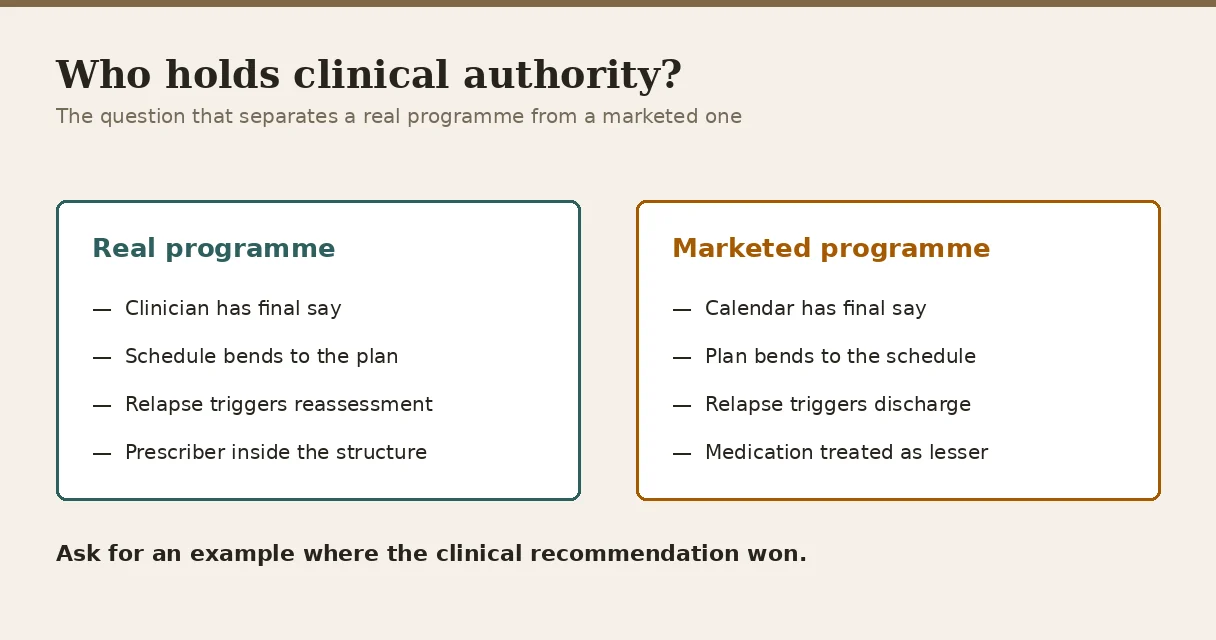
Who holds clinical authority when the schedule and the treatment conflict?
In a genuine programme, a clinician decides — and occasionally decides against the calendar. In a marketed one, the schedule wins and the clinical plan bends around it. Ask directly who has the final say when a board commitment collides with a clinical recommendation, and ask for an example of it having gone the clinical way.
Is medication offered, and by whom?
For alcohol and opioid use disorder, medication is first-line treatment rather than an optional support. A programme that treats it as a lesser path, or has no prescriber embedded in the structure, is out of step with the evidence regardless of how discreet its accommodation is. Our pages on alcohol and opioid treatment set out what that means clinically.
What happens if the executive relapses at day forty?
The answer should describe a clinical response — reassessment, level-of-care change, more contact. If the answer is discharge, the programme has converted its most dangerous moment into an unsupported one, and the discretion it sells becomes irrelevant at exactly the point it was bought for.
Who is told, and what is the smallest possible number?
Usually one person in HR or one board member, and disclosure can often be limited to dates and availability without naming a diagnosis. Federal confidentiality rules for substance use records are stricter than for ordinary medical care — see SAMHSA guidance on 42 CFR Part 2.
What does the family get, and when?
A named contact, a scheduled cadence, and an agreed scope of what will and will not be shared. Families of executives are frequently managed rather than involved, and the cost of that shows up in the return-to-work window rather than during the stay.
What is the plan for the first predictable high-risk event?
An offsite, a results week, an industry dinner. These are foreseeable, they arrive early in the return sequence, and a plan that has not named them is a plan that will meet them unprepared.
What this looks like against the standard levels of care
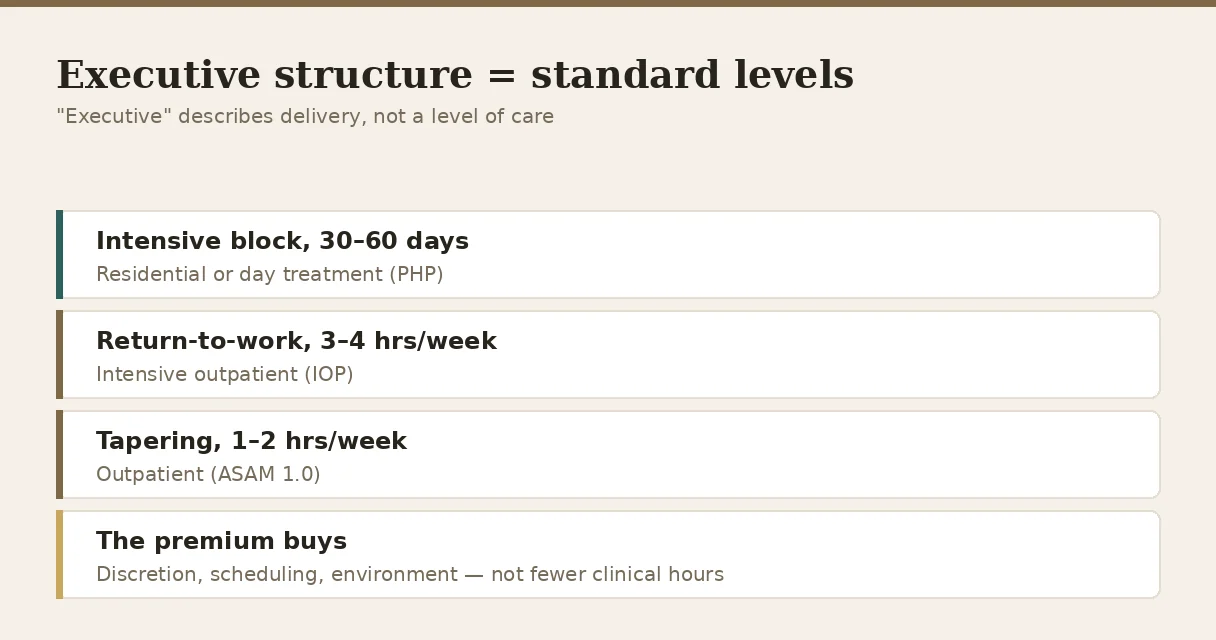
"Executive programme" is a description of delivery, not a level of care. Underneath the discretion, the scheduling and the private accommodation, the clinical structure is the same continuum everyone else uses — and it is worth knowing which level is actually being sold.
The intensive block is usually residential or day treatment
A thirty-to-sixty day partial-inpatient block corresponds to residential care or day treatment in standard terms. The difference is the room, the privacy and the communications arrangement — not the clinical hours.
The return-to-work sequence is intensive outpatient, tapering
Three to four hours of weekly clinical engagement is intensive outpatient territory at the top end and outpatient care as it tapers. Our comparison of the two levels explains how the hours define which is which.
Which means the cost question has a floor
If a programme charges a premium, the premium should buy discretion, scheduling and environment — not a reduced clinical dose. A programme delivering four weekly hours at a residential price is selling accommodation, and it is fair to say so out loud during the enquiry. Our guide to insurance covers what the clinical component typically recovers.
Clinical background for this article: NIDA on treatment approaches, SAMHSA TIP 47 on intensive outpatient care and the continuum, and the SAMHSA National Helpline for confidential referral at any hour.
Frequently asked questions
How long is an executive treatment program?
Variable. The standard executive sequence is sixty to one hundred twenty days total — a five-to-fourteen-day intensive intake, a thirty-to-sixty-day partial-inpatient block, and a ninety-day continuing-care return-to-work sequence. Some executives complete the structure in sixty days; others extend to one hundred fifty days. The schedule is clinician-determined based on treatment progress, not a fixed brochure tier.
Can I attend board meetings during treatment?
Yes, when fiduciary duty requires it. Board meeting attendance is conducted by encrypted video from a private workspace within the residence, with an NDA-bound communications coordinator managing the technical environment and the schedule. Pre-call briefings with the executive coach and post-call debriefs with the clinician are standard. Routine operational meetings are typically delegated to the designated officer (CFO or COO) by written succession instrument.
What employment law protections apply?
FMLA provides up to twelve weeks of unpaid job-protected leave for substance use disorder treatment (DOL guidance). ADA protects employees with substance use disorder who are not currently using illegal drugs, including those in active treatment and recovery, and requires reasonable accommodation for ongoing care. Executive employment agreements, change-of-control clauses, and D&O policies may have specific provisions that require legal review before leave begins.
Will my treatment be disclosed to my insurance company?
If you submit claims, yes — to the carrier and to your employer (if employer-funded plan) through the EOB and claim payment process, with HIPAA and 42 CFR Part 2 protections governing what is shared. If privacy concerns preclude insurance submission, treatment can be private-pay; medical expenses above 7.5% of AGI are deductible. A growing number of executives choose private-pay specifically to keep treatment outside the insurance claims record.
How do I tell my board, my staff, and my family?
In layers, with explicit consent. Inner circle (spouse, adult children, parents) receive full information and are typically part of family therapy during treatment. Trust circle (board chair, CFO/COO, outside counsel, one or two close peers) receive operationally-necessary information only — a defined medical leave, return horizon, point of contact, with no diagnosis or clinical detail. Outer circle (staff, broader board, counterparties) hear the standard "personal medical leave" framing through your designated workplace point of contact. The communications coordinator at the residence helps manage these boundaries.
What does the return to work actually look like?
A graduated ninety-day reintegration starting at sixty to seventy percent of pre-treatment intensity in week one back, increasing weekly. The first thirty days include three to four hours of weekly clinical engagement (individual therapy, IOP-style groups, MAT physician appointments if applicable, recovery coach check-ins). Days thirty to sixty: two to three hours weekly, eighty to ninety percent workplace. Days sixty to ninety: one to two hours weekly, full workplace. The graduated structure produces materially better outcomes than full-intensity return on day one.


