
Inpatient (residential) rehab means living at a treatment facility, typically for 30 to 90 days, with structured clinical care and no access to the environment where use happened. It is the right level of care when withdrawal is medically risky, when a person has co-occurring psychiatric illness, or when the home environment itself sustains the disorder: the six ASAM dimensions, not severity alone, decide. The strongest single evidence point on length is NIDA's: episodes shorter than 90 days are of limited effectiveness, and duration of care predicts outcome better than intensity does. Alcohol is the most common reason for admission, and inpatient rehab is not a cure: it is the start of a chronic-illness treatment plan whose first ninety days after discharge matter most.
- Who needs it is decided by six ASAM dimensions (withdrawal risk, medical status, psychiatric status, readiness, relapse potential, and living environment) not by how much someone drinks or uses.
- On length, the evidence is unusually clear: NIDA holds that episodes under 90 days have limited effectiveness. A 30-day stay is a beginning, not a complete course.
- Alcohol drives most inpatient admissions, largely because alcohol withdrawal can be medically dangerous and needs supervision that outpatient care cannot provide.
- Phone, laptop and work policies vary enormously and are rarely published: for anyone with genuine professional obligations, this is the question to ask before the deposit, not after.
- Relapse is not treatment failure: NIDA puts SUD relapse rates at 40–60%, comparable to asthma and hypertension. The measure that matters is whether someone is still in care at ninety days.
minimum program duration NIDA associates with meaningful effectiveness
Source: NIDA
relapse rate for substance use disorder — comparable to other chronic illness
Source: NIDA
ASAM dimensions that determine the appropriate care levels, not severity alone
Source: ASAM Criteria
insurance coverage for residential treatment is protected under federal law
Source: U.S. DOL
What inpatient rehab is — and the two different things people mean by it
Search for "inpatient rehab" and you will find two entirely unrelated kinds of care. One is post-acute medical rehabilitation: inpatient rehabilitation facilities where people recover after a stroke, a joint replacement, or a serious injury, doing physical, occupational and speech therapy. The other, and the subject of this page, is residential treatment for substance use disorder. The phrase is identical; the medicine has almost nothing in common. If you arrived here looking for rehabilitation after surgery or stroke, that care is arranged through the discharging hospital.
Residential addiction treatment means living at a facility for a defined period, typically thirty to ninety days, inside a structured clinical program. In the ASAM framework it spans Level 3.1 (clinically managed low-intensity residential), Level 3.5 (clinically managed high-intensity), and Level 3.7 (medically monitored intensive inpatient, with 24-hour nursing). The defining feature is not the therapy on offer, which largely also exists in outpatient care. It is the removal of the environment: the people, places, supply and routine that sustained the pattern are simply unavailable for the duration.

What does inpatient mean? Inpatient treatment in plain terms
In medicine, inpatient means you are formally admitted and stay overnight; outpatient means you are seen and go home the same day. The words describe where you sleep, not how serious the problem is or how good the care will be.
Addiction care uses the words more loosely. Most people who say "inpatient rehab" mean a residential treatment center: a licensed facility where you live for several weeks. Insurers and the ASAM Criteria are stricter. Level 3.7 is the medically monitored tier with 24-hour nursing, Level 4 is hospital-based inpatient care, and Levels 3.1 and 3.5 are clinically managed residential care led by counselors and therapists. Ask which level a program is licensed for before you compare prices, because the level decides how much medical staff is on site at night.
- Hospital inpatient care (Level 4): acute medical or psychiatric instability, or complicated withdrawal.
- Medically monitored residential (Level 3.7): round-the-clock nursing with a physician on call.
- Clinically managed residential (Levels 3.1 and 3.5): structured live-in treatment without continuous medical care.
Inpatient versus outpatient: what actually differs
The two are often presented as a preference. They are not. They are different intensities on a continuum, and the honest comparison is about what each can and cannot contain.
The continuum, side by side
| Inpatient / residential | Partial hospitalization (PHP) | Intensive outpatient (IOP) | |
|---|---|---|---|
| Where you sleep | At the facility | At home | At home |
| Clinical hours | Structured program, most of the day | Roughly full days, most weekdays | Several sessions weekly, often evenings |
| Medical supervision | On site; 24-hour nursing at 3.7 | During program hours | Scheduled appointments |
| Environment removed | Yes: the central mechanism | No: evenings and weekends at home | No |
| Work continues | Only where a program permits it | Difficult but sometimes possible | Usually yes |
| Best suited to | Withdrawal risk, comorbidity, unsafe home | Needs intensity, has a stable home | Step-down, or milder presentations |
Choosing a lower level because it is less disruptive, rather than because it matches the clinical picture, is the single most common and most expensive mistake in this decision.

Inpatient vs outpatient rehab: how to decide in five questions
The difference between inpatient and outpatient rehab is the environment, not the therapy. Both use the same core treatments: counseling, cognitive behavioral therapy, and medication where it is indicated. Inpatient removes you from home for the duration; outpatient fits treatment around the life you already have. A clinician will ask some version of each of these.
- Could withdrawal be dangerous? Heavy daily drinking, benzodiazepine dependence, or a past withdrawal seizure points toward supervised care first.
- Is home safe and substance-free? If someone you live with is using, or supply is within reach, outpatient is fighting the environment every evening.
- Has outpatient already been tried properly? Relapse after a full outpatient course is a reason to step up, not to repeat the same plan harder.
- Is there a co-occurring condition? Severe depression, suicidal thinking, or an untreated psychiatric illness usually needs the closer watch of residential care.
- What has to keep running? Work, children and caregiving are real constraints. Outpatient care, an intensive outpatient program, or partial hospitalization can deliver intensity without a bed.
If most answers point one way, that is your starting level. If they split, start at the more intensive level and step down early; moving down is easier than recovering from a relapse caused by starting too low. For the middle ground, see partial hospitalization and intensive outpatient programs.
Who actually needs residential care
This is not decided by how much someone drinks or uses. ASAM assesses six dimensions, and a serious problem in any one of them can indicate residential care even when the others look manageable.
1. Withdrawal potential
Is withdrawal likely to be medically dangerous? Alcohol and benzodiazepines can produce seizures and delirium. This dimension alone frequently decides the question.
2. Biomedical conditions
Liver disease, cardiac problems, pregnancy, poorly controlled diabetes, chronic pain on opioids: medical complexity that outpatient care cannot monitor.
3. Emotional and cognitive
Co-occurring depression, bipolar disorder, PTSD, or suicidal thinking. Roughly half of people with a substance use disorder have a co-occurring mental illness, and treating one alone tends to fail.
4. Readiness to change
Ambivalence is normal and is not disqualifying. But someone who cannot yet commit to attending outpatient sessions reliably may need the structure that residential provides.
5. Relapse potential
A history of repeated relapse from lower levels of care is meaningful clinical evidence, not a character judgment. It argues for more containment, not more willpower.
6. Recovery environment
The dimension people underestimate. If the home contains an active supply, a using partner, or the unmanaged stressor that drives use, treating someone inside that environment is fighting uphill every night.

Alcohol: the most common reason for admission
Alcohol accounts for a large share of residential admissions, and for a specific clinical reason rather than a cultural one. Alcohol withdrawal is one of the few withdrawals that can kill. Symptoms typically begin six to twenty-four hours after the last drink; seizure risk concentrates in the first forty-eight hours; delirium tremens, when it occurs, usually appears between forty-eight and ninety-six hours and is a medical emergency. Outpatient care cannot observe someone through that window.
Inpatient alcohol treatment therefore usually begins with medically supervised withdrawal management and then continues into the residential program proper. That continuity matters: a person who detoxes in one place and is discharged to arrange treatment elsewhere frequently never arrives.
Three medications are FDA-approved for alcohol use disorder, and they are markedly underused. Naltrexone reduces heavy drinking and craving, available as a daily tablet or monthly injection. Acamprosate supports abstinence once withdrawal has resolved and is often chosen where liver function is a concern. Disulfiram produces an aversive reaction to alcohol and suits a specific, motivated subset, particularly with supervised dosing. A residential program that discharges someone with alcohol use disorder without having discussed all three has left the most evidence-backed tool in the box.
Naltrexone
FDA-approved for AUDReduces heavy drinking and craving by blunting alcohol's rewarding effect. Available as a daily tablet or a monthly injection, which removes the daily decision entirely, often the deciding factor for people whose mornings are unreliable early in recovery.
Acamprosate
FDA-approved for AUDSupports continued abstinence once withdrawal has resolved, and is frequently preferred where liver function is a concern, since it is not metabolized by the liver. Requires consistent dosing across the day.
Disulfiram
FDA-approved for AUDProduces an unpleasant physical reaction if alcohol is consumed. It suits a specific, motivated subset: evidence is strongest where dosing is observed by someone else rather than self-administered.

I cannot disappear for a month. I have a company to run.
That objection is treated as denial far too often, and frequently it is simply true. Two honest responses exist. Some programs permit scheduled laptop and phone access, structured work windows, and private rooms: those policies are real, they vary enormously, and almost nobody publishes them, so you have to ask directly. And where residential genuinely is not possible, partial hospitalization delivers clinical intensity comparable to residential during the day while you sleep at home. What does not work is choosing the least disruptive option and hoping it matches a severity it was never designed for.
Will anyone find out I was here?
Treatment records are protected health information, and substance use disorder records carry additional federal protection under 42 CFR Part 2, which is stricter than HIPAA alone. Practically, discretion is a service question as much as a legal one: ask about private rooms, about who answers the phone and what they say, about whether other guests share communal spaces, and about how correspondence and billing arrive. A program used to treating recognisable people answers these without hesitation.
Does inpatient rehab even work? I have heard the numbers.
You have probably heard relapse rates quoted as if they were a verdict. NIDA puts substance use disorder relapse at 40–60%, which sits alongside asthma and hypertension: chronic conditions nobody calls untreatable. Relapse signals that treatment needs adjusting, not that it failed. The honest framing is this: a single 30-day stay with no aftercare has poor odds, and continuous engagement past ninety days changes them substantially. What you do after discharge matters more than where you stayed.
Thirty, sixty or ninety days: what each length buys
Program lengths are largely inherited from insurance history rather than from biology: the twenty-eight day model has more to do with mid-century coverage design than with any clinical threshold. What the research does support is that duration predicts outcome. NIDA states plainly that participation for less than ninety days is of limited effectiveness, and that longer episodes are recommended for maintaining positive outcomes.
What actually happens in each window
| Length | What it realistically achieves | Where it falls short | Typically suits |
|---|---|---|---|
| 30 days | Withdrawal resolved, acute crisis stabilized, treatment plan built, first therapeutic work begun | Little time to practice new behavior; discharge lands close to the highest-risk period | First episode, strong home support, immediate step-down arranged |
| 60 days | Psychiatric picture becomes clear once substances are gone; therapy reaches underlying material; routines form | Still short of the ninety-day threshold the evidence points to | Co-occurring conditions, prior relapse from a 30-day stay |
| 90 days | Sustained practice of new behavior, family work, realistic relapse-prevention rehearsal, medication stabilized | Longest disruption to work and family life | Long histories, repeated relapse, unstable home environment |
| Longer | Extended care and sober living continue the structure at lower cost and intensity | Requires a genuine plan rather than open-ended stay | Where the environment to return to is still the problem |
A useful reframe: ninety days does not have to mean ninety residential days. Thirty residential followed by partial hospitalization and intensive outpatient can reach the same continuous-engagement threshold, often more affordably.

What the days actually look like
Programs differ, but the shape is remarkably consistent, and knowing it removes a good deal of the fear that keeps people from going.
Mornings start early and deliberately so: restoring sleep and circadian rhythm is treatment, not scheduling. A typical morning runs a check-in or reflection group, breakfast, then the day's first clinical block: usually group therapy, which does more of the work than most people expect. Individual therapy generally happens two or three times a week rather than daily, which surprises people who imagined the reverse. Afternoons carry psychoeducation, specialized groups such as trauma or relapse prevention, and physical activity. Evenings are lighter: peer support meetings, reflection, structured free time.
Family involvement is usually scheduled rather than casual: a family program, therapy sessions, or defined visiting periods. Medical and psychiatric review continues throughout, with medication adjusted as the picture clarifies once substances are out of the system. The consistent surprise for new arrivals is how little unstructured time exists, and how much of the therapeutic effect comes from that structure rather than from any single session.
Morning
Early wake, check-in or reflection group, breakfast, then the first clinical block, usually group therapy. Restoring sleep and circadian rhythm is treatment in itself, which is why the start time is not negotiable in most programs.
Afternoon
Psychoeducation, specialized groups such as trauma work or relapse prevention, individual therapy for those scheduled that day, and physical activity. Medical and psychiatric review happens through this window as the clinical picture clarifies.
Evening
Lighter by design: peer support meetings, reflection or journalling, structured free time, and, where the program permits it, scheduled contact with family or work. Lights out is early, and enforced.

The first week is the hardest — and where people leave
Early departure is the most under-discussed risk in residential treatment. The first days combine physical discomfort, a sudden loss of autonomy, the shock of communal living, and the arrival of emotions that substances were managing. Around the same moment, acute withdrawal resolves and the person feels physically better. Feeling better while feeling trapped is precisely the combination that produces a decision to leave.
This is worth naming in advance for two reasons. First, knowing the pattern is protective: expecting day three or four to be the low point makes it survivable rather than evidence that the place is wrong. Second, it is a fair question to ask a program: what is their early-departure rate, and what do they do when someone wants to go? A program that has thought about this has answers. One that treats it as a character failure has not.

Phones, laptops and work: the policies nobody publishes
For anyone with genuine professional obligations, this is the decisive practical question, and it is remarkably hard to get answered from a website. Whether a program allows phones at all, and from which day, varies enormously: policies run from complete confiscation for the entire stay, through phased access earned over time, to scheduled daily windows with a laptop in a private room. All three exist. None of them is disclosed on most program pages, which is why the question has to be asked explicitly.
There is a real clinical argument behind restriction: the phone is where the supply, the using contacts, and much of the stress live, and early separation from it genuinely helps. There is an equally real counter-argument: someone who refuses treatment entirely because they cannot vanish for a month receives no treatment at all, and a policy that produces that outcome has not protected anyone.
Ask these five things directly, and ask them before any deposit. What is the phone policy in the first week, and how does it change after that? Is laptop use permitted, and where? Can I take scheduled calls, and with how much notice? Is there private space to work, or only communal areas? And what happens if a genuine emergency arises at my company, who decides? Programs accustomed to treating executives and clinicians answer these fluently. Hesitation is itself informative.

Private rooms, and what luxury changes clinically
It would be dishonest for this site to pretend comfort is irrelevant. Private rooms mean sleep, and sleep is genuinely therapeutic in early recovery. Lower staff-to-patient ratios mean more individual therapy and faster psychiatric review. Good food matters more than it sounds when someone is nutritionally depleted. Discretion protects careers and families, and for people whose alternative is refusing care altogether because they cannot risk recognition, that protection is clinical rather than cosmetic.
The line worth holding is this: comfort improves retention, and retention improves outcomes, but comfort is not itself treatment. A beautiful residence with thin clinical staffing, no psychiatric coverage, and no medication prescribing is a worse choice than a plain one with all three. The questions that separate them are unglamorous: who is on site overnight, who prescribes, how often does a psychiatrist actually see patients, and what is the accreditation. Ask those first, and let the photographs be the tiebreaker rather than the argument.
Does inpatient rehab actually work?
This deserves a direct answer rather than a reassuring one. Addiction is a chronic, relapsing condition, and NIDA places relapse rates for substance use disorder at 40 to 60 percent: squarely in the range reported for asthma and hypertension, conditions nobody describes as untreatable. A relapse indicates that treatment should be resumed or adjusted, in exactly the way a returning asthma symptom does.
What genuinely moves the odds is reasonably well established. Duration of engagement matters more than intensity: the ninety-day threshold recurs throughout the literature. Medication, where indicated, changes outcomes substantially for opioid and alcohol use disorder, and remains underused in residential settings. Continuing care after discharge is close to decisive, and a program without a concrete step-down plan is handing back the hardest part unsupported. And treating co-occurring psychiatric illness concurrently rather than sequentially is what separates a durable result from a revolving door.
What no honest program promises is a cure, a guaranteed success rate, or a number derived from its own unaudited follow-up. Published success percentages in this industry are marketing rather than measurement, and a program quoting one should be asked how it was calculated, who was counted, and what happened to the people who could not be reached.

What it costs and how insurance handles it
Residential treatment is priced per day, and the range across the market is enormous: from state-funded programs at no cost to private residences billing several thousand dollars a day. A daily rate on its own is close to meaningless: the comparison only becomes real once you know the ASAM level, the staffing, whether medical and psychiatric care are included or billed separately, and what the figure covers on the day of admission and discharge.
On insurance, federal parity law prohibits applying substance use disorder benefits more restrictively than medical and surgical benefits. In practice, residential is the level insurers examine most closely, and authorization is granted in reviewed increments rather than for a whole stay up front. That has a practical consequence worth understanding: continued authorization depends on documentation from the treating program; ASAM-based justification across all six dimensions and evidence of ongoing medical necessity. A program experienced in concurrent review is worth considerably more than it appears on a brochure.
Most serious private residences are out of network. Where that is the case, the questions that decide the real number are the out-of-network residential benefit, the deductible position, the out-of-pocket maximum, and whether a single-case agreement is achievable. Our carrier guidance works through exactly these questions for Aetna, Blue Cross Blue Shield, Cigna, UnitedHealthcare and Humana.

Choosing a residential treatment center: what to verify
A residential treatment center should be able to show you each of the following in writing. None of it is unusual to ask for, and hesitation is an answer in itself.
- A state license for the level of care it sells. Licensing is done by the state, and your state health or behavioral health department lists licensed facilities.
- Accreditation from The Joint Commission or CARF. It is voluntary, but it means outside surveyors have reviewed the program.
- The ASAM level of each bed (3.1, 3.5 or 3.7), which tells you who is on site overnight.
- Medication access. Ask whether the program starts or continues buprenorphine, methadone or naltrexone. In our count below, about one residential listing in five reports no opioid medication at all.
- Detox location. If withdrawal is a concern, ask whether detox happens on site or at a partner hospital.
- The discharge plan: who you will see in the first week after leaving, booked before you are admitted.
The federal locator at FindTreatment.gov filters by residential setting, payment and medication, and the SAMHSA National Helpline (1-800-662-4357) is free, confidential and open around the clock.
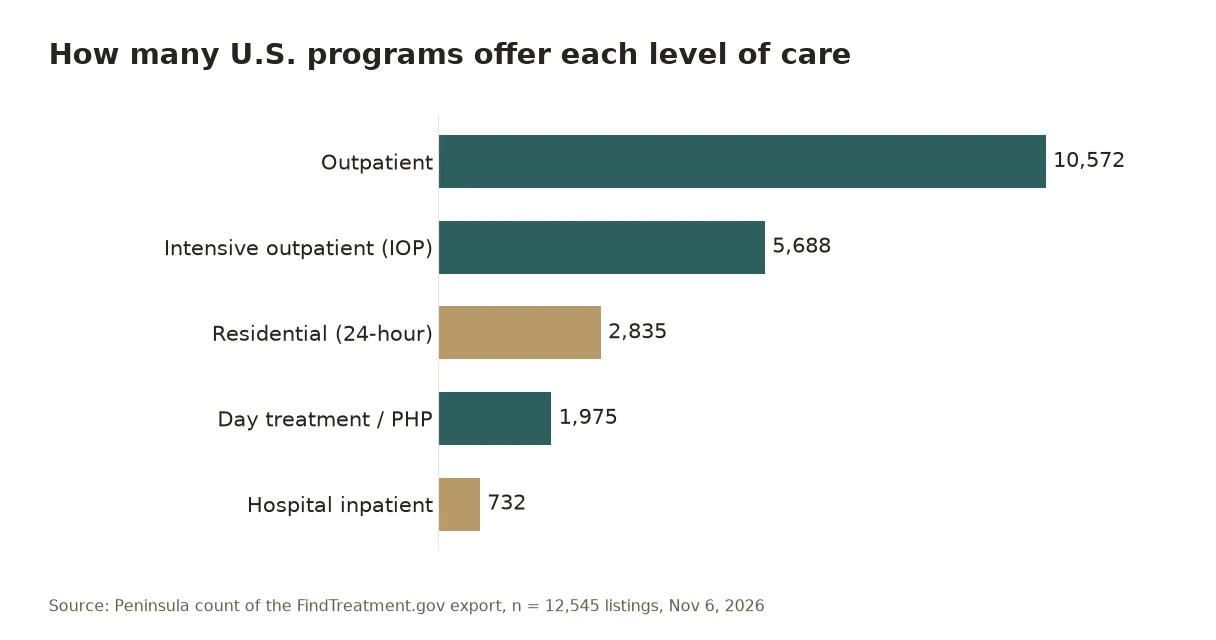
What 2,835 residential programs report: our count of SAMHSA data
We downloaded the full federal FindTreatment.gov list of substance use treatment facilities and counted what residential programs report about themselves. These are self-reports to SAMHSA, not inspections, but they show what you can reasonably expect to find.
| What the listing reports | Count | Share |
|---|---|---|
| Listings offering residential (24-hour) care | 2,835 of 12,545 | 22.6% |
| Outpatient listings for each residential one | 10,572 vs 2,835 | 3.7 to 1 |
| Short-term / long-term residential | 1,983 / 2,051 | 15.8% / 16.3% |
| Hospital inpatient listings | 732 | 5.8% |
| Residential programs accepting Medicaid | 1,914 of 2,835 | 67.5% |
| Residential programs accepting private insurance | 2,043 of 2,835 | 72.1% |
| Residential programs using any opioid medication | 2,202 of 2,835 | 77.7% |
| Residential programs with on-site detox | 1,163 of 2,835 | 41.0% |
Source: Peninsula count of the FindTreatment.gov facility export (substance use, all U.S. listings, downloaded November 6, 2026; n = 12,545 listings). Facilities self-report their services to SAMHSA; a facility can list several settings, and some organizations appear once per site.
Two practical reads. Fewer than half of residential programs detox on site, so if withdrawal is a concern, ask where it happens before you book. And about 22% list no opioid medication, which matters if opioids are involved at all.
Questions to ask before you admit
Six questions that separate programs quickly, none of which require clinical training.
What ASAM level are you, and is nursing on site overnight?
The answer should be specific (3.1, 3.5 or 3.7) and immediate. "On call" is not the same as on site, and for anyone with withdrawal risk that distinction is the whole conversation.
Who prescribes, and how often is a psychiatrist on site?
If nobody at the program can start naltrexone or buprenorphine, or review psychiatric medication weekly, the most evidence-backed parts of treatment are being deferred to someone you have not met.
What are the phone, laptop and work policies, exactly?
Ask for the first week and for afterwards, separately. Vague answers here reliably become conflict later, usually in week one.
What is your accreditation, and by whom?
Independent accreditation is a floor rather than a distinction, but its absence is informative. Ask which body and when it was last reviewed.
What happens if I want to leave on day four?
Every program meets this. The good ones have a considered clinical answer; the rest have a policy about deposits.
What exactly is the step-down plan, and who arranges it?
The correct answer names a level of care, a start date, and a person: arranged during the stay, not discussed on the final morning.
What comes after: the ninety days that decide it
The measure of a residential stay is not how it felt on discharge day. It is whether the person is still in treatment three months later. Everything about the discharge plan should be built with that in mind, and it should be settled weeks before the end rather than in a final meeting.
A realistic plan usually combines several things: a step down to partial hospitalization or intensive outpatient rather than straight to nothing; medication for opioid or alcohol use disorder, decided explicitly rather than omitted by default; continued psychiatric care where a co-occurring condition exists; and a living situation that is not the environment that produced the problem, which for some people means sober living for a period, and for others means changes at home negotiated during family work.
The pattern to avoid is the one that recurs most: an excellent, expensive residential stay, a discharge with a list of phone numbers, and a relapse inside a month. That outcome is rarely a failure of the residential program itself. It is the predictable result of treating a chronic condition with an intensive episode and no continuing care.
This is general information, not medical advice
Clinical protocols, durations, and costs vary by individual history and by programme. Figures on this page are typical ranges and illustrative examples, not medical advice and not a quote. Withdrawal from some substances can be dangerous; decisions about level of care belong with a qualified clinician who has examined you. For free, confidential help finding treatment, call SAMHSA 1-800-662-HELP.
Inpatient Rehab coverage, answered
How long is inpatient rehab?
What is the difference between inpatient and residential rehab?
Is inpatient rehab the same as rehab after a stroke or surgery?
Do I really need inpatient, or would outpatient do?
Can I use my phone or laptop in rehab?
Can I keep working during inpatient treatment?
What does inpatient rehab cost?
Does insurance cover inpatient rehab?
What happens in the first week?
What is a typical day like?
Does inpatient rehab work?
Will my employer or family find out?
What is the difference between inpatient and outpatient rehab?
What does inpatient mean in rehab?
Is residential treatment the same as inpatient rehab?
How do I find an inpatient alcohol rehab near me?
Explore the full continuum of care
Sources & references
- NIDA — Principles of Drug Addiction Treatment: A Research-Based Guide
- NIDA — Treatment and Recovery
- SAMHSA — National Helpline and treatment locator
- SAMHSA — 42 CFR Part 2: confidentiality of SUD patient records
- American Society of Addiction Medicine — The ASAM Criteria
- NIAAA — Alcohol Use Disorder: treatment options
- NIMH — Substance Use and Co-Occurring Mental Disorders
- MedlinePlus — Alcohol withdrawal
- U.S. Department of Labor — Mental Health and Substance Use Disorder Parity
Reviewed November 6, 2026 · Peninsula editorial standards. Inpatient Rehab-specific facts cite Inpatient Rehab plan documentation; regulatory facts cite U.S. federal sources.
Know your Inpatient Rehab numbers first.
A twenty-five-minute call establishes your out-of-network residential benefit, deductible status, and whether a single-case agreement is worth pursuing: a written best, middle, and worst-case cost scenario for your specific plan.